
Saudi Arabia is no longer a market where starting a business means choosing between a few traditional sectors. The Kingdom’s economic transformation is creating opportunities across e-commerce, artificial intelligence, cybersecurity, tourism, logistics, professional services, digital products, entertainment, food, education and specialized business services.
But there is an important distinction between a good business idea and a business you can legally and commercially operate.
Before investing money, you need to answer five questions:
This guide explains the 15 business opportunities worth considering in Saudi Arabia in 2026, the evidence behind them, who they may suit, and what you should consider before setting up.
Important: Business activity eligibility, licensing requirements, ownership rules and government fees vary by activity and investor profile. Always verify the requirements applicable to your specific activity before committing capital.
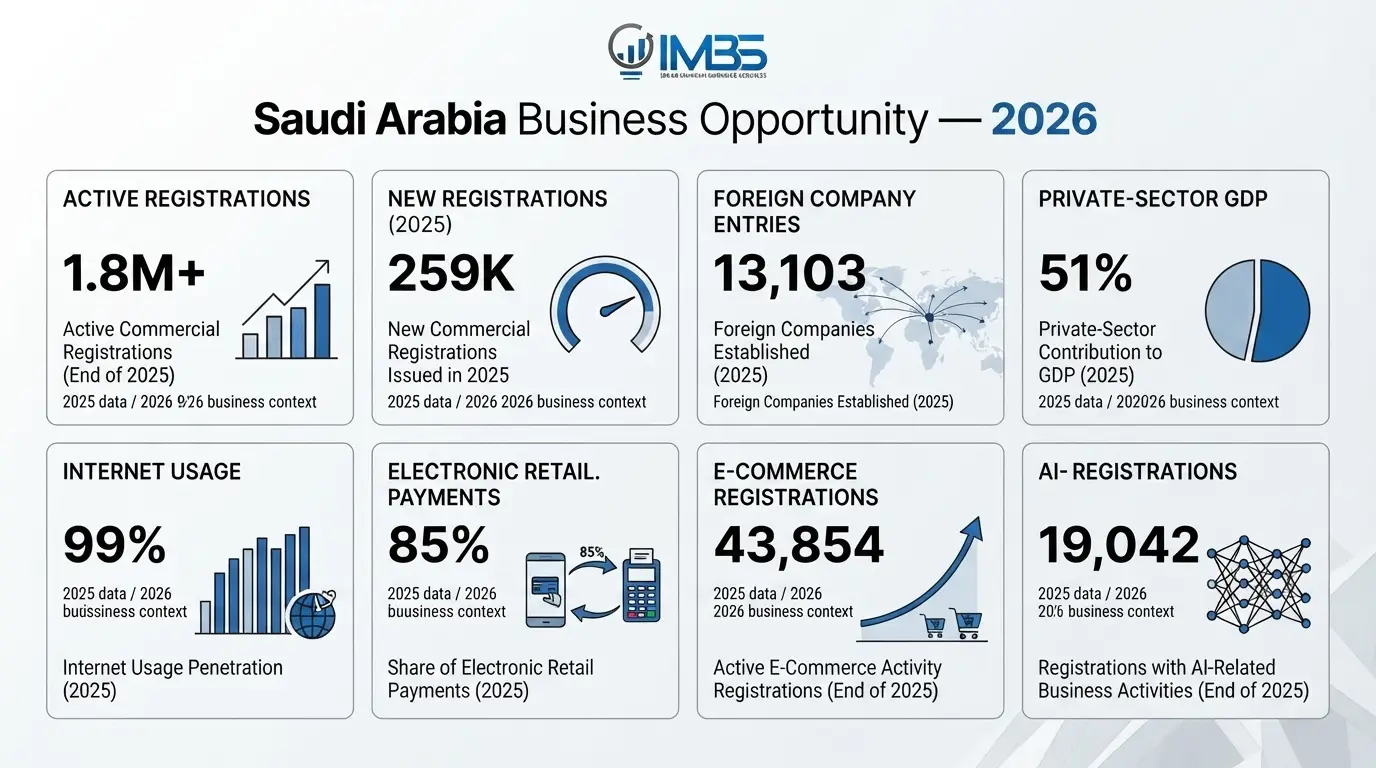
Saudi Arabia’s business opportunity is increasingly supported by measurable economic and digital growth rather than simply optimism around Vision 2030.
The Ministry of Commerce reported that Saudi Arabia had more than 1.8 million active commercial registrations in 2025, including approximately 259,000 new registrations and 13,103 foreign company entries. The private sector’s contribution to GDP reached 51%, while SMEs contributed 22.9%.
The digital economy is particularly significant.
According to Saudi Arabia’s General Authority for Statistics, 99.0% of individuals aged 15–74 used the internet in 2025, while 96.2% participated in social media networks. The same survey reported that 57.2% used the internet to obtain information about goods or services.
Electronic payments are also becoming the norm. The Saudi Central Bank reported that electronic payments represented 85% of total retail payments in 2025, compared with 79% in 2024, with 14.6 billion electronic transactions recorded during 2025.
E-commerce is another strong signal. Monsha’at’s e-commerce report identified 42,900 online stores accessible in Saudi Arabia, 34.5 million projected e-commerce users by 2025 and a 15% compound annual growth expectation for e-commerce during 2020–2025.
More recent Ministry of Commerce data shows that commercial registrations for e-commerce activities reached 43,854 in 2025, compared with 40,041 in 2024 — an increase of about 9.5%.
These numbers do not guarantee that any particular business will succeed. They do, however, show why Saudi Arabia’s digital and private-sector economy deserves serious attention.
There is no universal "most profitable business." The right opportunity depends on your capital, experience, target customers, business activity, location and regulatory requirements.
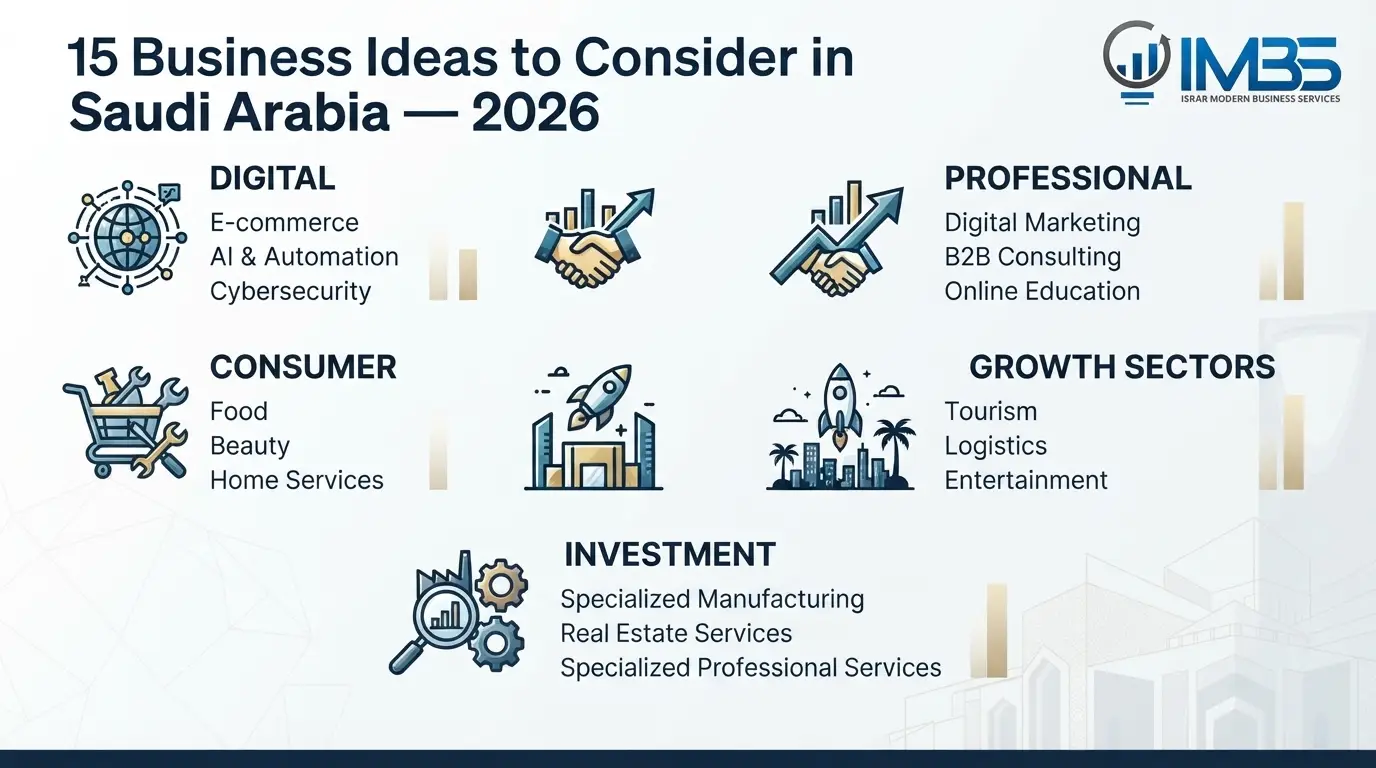
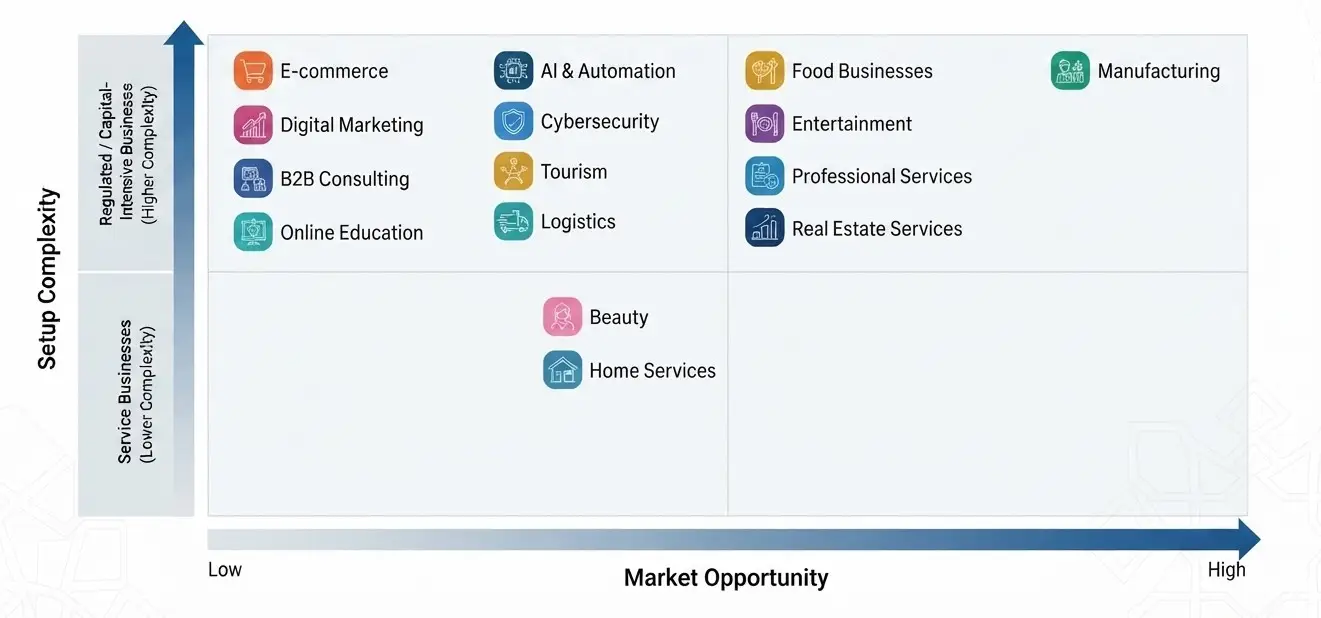
For practical comparison, the opportunities below are grouped by their general business model and setup complexity.
| Business idea | Demand signal | Typical complexity | Best suited for |
|---|---|---|---|
| E-commerce | Very strong | Medium | Entrepreneurs & brands |
| AI & automation services | Strong | Medium | Technology professionals |
| Cybersecurity services | Strong | Medium–High | Cybersecurity specialists |
| Digital marketing | Strong | Low–Medium | Agencies & freelancers |
| B2B consulting | Strong | Low–Medium | Experienced professionals |
| Online education | Growing | Low–Medium | Trainers & educators |
| Tourism experiences | Growing | Medium–High | Tourism operators |
| Logistics & delivery | Strong | High | Operators & investors |
| Food & cloud kitchens | Strong | Medium–High | Food entrepreneurs |
| Beauty & personal care | Strong | Medium | Brands & retailers |
| Home & facility services | Strong | Medium | Service businesses |
| Specialized professional services | Strong | Medium | Experts |
| Entertainment & events | Growing | Medium–High | Creative businesses |
| Specialized manufacturing | Strong | High | Investors |
| Real-estate-related services | Strong | Medium–High | Property professionals |
The table is a strategic comparison, not a government classification or guarantee of profitability.
E-commerce remains one of the clearest opportunities for entrepreneurs who can identify a specific customer problem and build a focused product offering around it.
Saudi Arabia’s e-commerce commercial registrations increased from 40,041 in 2024 to 43,854 in 2025, according to the Ministry of Commerce.
The opportunity is not necessarily to build another general online store.
A modern online business connects customers, digital commerce, payments, marketing, fulfillment and customer service.[/caption]
A better approach is to identify a specific niche.
Examples include:
The important lesson from successful e-commerce businesses is simple:
Do not start with “What can I sell?” Start with “Which customer problem can I solve better?”
Entrepreneurs with:
Check:
Saudi Arabia’s Ministry of Commerce provides an e-commerce regulatory framework, including the E-Commerce Law, implementing regulations and guidance for online stores.

Artificial intelligence is one of the most interesting business opportunities emerging from Saudi Arabia’s digital transformation.
The Ministry of Commerce reported 19,042 commercial registrations associated with AI technology activities in 2025, compared with 14,163 in 2024 — an increase of approximately 34.5%.
This does not mean every AI startup will succeed.
It does mean businesses are increasingly commercializing AI-related activities.
Possible business models include:
A particularly attractive model for smaller businesses is AI-as-a-service rather than building a large AI product from scratch.
For example:
A company could automate customer enquiries, lead qualification, appointment scheduling and internal document processing for SMEs.
The customer pays for a measurable business outcome rather than simply “AI.”
AI businesses may involve technology, consulting or other activity classifications depending on what you actually provide. Confirm the appropriate activity and any applicable approvals before registration.
Cybersecurity is another sector showing measurable growth.
Saudi Arabia recorded 9,766 commercial registrations associated with cybersecurity activities in 2025, compared with 7,689 in 2024 — an increase of approximately 27%.
Potential business models include:
This opportunity is particularly suitable for professionals with recognized technical skills and enterprise experience.
However, cybersecurity is not simply a freelance service category. Depending on the exact activity and customers, regulatory, contractual, data-protection and sector requirements may apply.
Saudi businesses are increasingly competing for customers through digital channels.
The country’s internet penetration provides a large addressable digital audience: 99% of individuals aged 15–74 used the internet in 2025, according to GASTAT.
A digital marketing company can specialize instead of trying to serve everyone.
Examples:
A specialized agency may be easier to position than a generic “full-service digital agency.”
For example:
“SEO for Saudi healthcare businesses”
is a clearer proposition than:
“We provide digital marketing.”
If you already have valuable professional expertise, consulting can be one of the most capital-efficient business models.
Possible areas include:
The advantage is that you are primarily monetizing knowledge and experience rather than inventory.
However, consulting activities can have activity-specific professional or regulatory requirements. Do not assume that because a service can be delivered online, it requires no formal business setup.
Saudi Arabia’s digital infrastructure makes online education increasingly accessible.
Possible businesses include:
The strongest opportunity is often not “create a course.”
It is:
Identify a valuable skill → identify a specific audience → create an outcome-based learning product.
For example:
“AI automation for Saudi SME managers”
is more commercially specific than:
“Learn artificial intelligence.”
Depending on the subject and delivery model, educational activities may involve additional regulatory requirements.
Tourism is one of the sectors receiving significant attention in Saudi Arabia’s economic diversification.
The Ministry of Commerce reported that commercial registrations for tourism trip-organizing activities increased from 6,476 in 2024 to 10,665 in 2025, representing growth of roughly 65%.
Potential opportunities include:
This sector can be attractive, but tourism activities often involve specific licensing and regulatory requirements.
The right question is therefore not:
“Can I start a tourism company?”
It is:
“Which tourism activity do I want to conduct, and which authority regulates it?”
Saudi Arabia’s geographic scale, growing e-commerce ecosystem and continued digital commerce adoption create opportunities throughout logistics.
Potential models include:
This is generally more capital-intensive than digital consulting or e-commerce.
It can require:
Therefore, logistics is better suited to entrepreneurs with operational expertise or access to investment capital.
Food remains one of the most recognizable consumer-business opportunities.
Possible models include:
A cloud kitchen can reduce the need for a traditional customer-facing restaurant, but it does not automatically eliminate regulatory requirements.
The exact activity, location, food handling, municipality requirements and other approvals should be determined before investment.
Beauty and personal care can work particularly
well when combined with:
Potential niches include:
The opportunity is attractive for brands that can differentiate themselves rather than simply resell identical products.
Product-specific regulations, labeling and approvals must be considered before importing or selling certain products.
A service business does not need to be entirely digital to benefit from digital demand.
Examples include:
A modern version of this model combines offline service delivery with online customer acquisition.
For example:
Customer discovers the company through Google → books online → receives automated confirmation → technician visits → invoice is issued digitally → customer receives follow-up.
The technology becomes the competitive advantage even though the service itself is physical.
Saudi Arabia’s growing business base creates opportunities for specialized B2B services.
Examples include:
The key is specialization.
Instead of:
“We provide business services.“
consider:
“Back-office support for Saudi e-commerce companies.“
The narrower positioning makes the customer, problem and value proposition clearer.
The entertainment economy has also shown measurable growth.
According to Ministry of Commerce data, commercial registrations for entertainment-city and games-related activities increased from 7,071 in 2024 to 8,376 in 2025, while registrations for operating entertainment-event facilities increased from 8,672 to 10,402.
Possible opportunities include:
As with tourism, the exact activity matters because regulatory requirements differ across business models.
Manufacturing is not a low-capital startup category, but it can represent a significant opportunity for investors with appropriate resources.
Potential areas include:
The advantage of manufacturing is that a successful operation can create a defensible supply-chain position rather than competing purely on digital advertising.
The disadvantage is complexity.
You may need:
Saudi Arabia’s expanding business and tourism ecosystem creates opportunities across property-related services.
Potential models include:
Real estate is highly regulated, so the exact service must be identified before selecting an activity or applying for a license.
The biggest mistake is choosing a business because someone says it is "profitable."Instead, score your idea against six factors.
Are customers already spending money on this problem?
Why would customers choose you?
How much money can you realistically commit before revenue?.
How many approvals, licenses or sector requirements apply?
Can you reach customers at a sustainable cost?
Do you have experience, relationships, technology or knowledge that gives you an advantage?
Opportunity Score = Demand + Founder Advantage + Market Access − Capital Risk − Regulatory ComplexityThis isn't a financial valuation formula. It is a decision-making framework to force you to examine the business from multiple angles.
There is no government-defined “best low-cost business.”
However, businesses based primarily on skills and services generally require less upfront capital than businesses requiring inventory, vehicles, factories or physical premises.
Examples may include:
That does not mean these businesses are automatically easy or profitable.
The real advantage is that the entrepreneur may be able to validate demand before making a large capital investment.
For an online-first entrepreneur, consider:
The important distinction is:
Online does not mean unregulated.
Saudi Arabia has an established e-commerce regulatory framework, including the E-Commerce Law, implementing regulations and official guidance for electronic stores.
The Ministry of Commerce also provides an electronic Commercial Registration service through the Saudi Business Center, allowing eligible businesses to begin registration electronically.
There is no government-defined “best low-cost business.”
However, businesses based primarily on skills and services generally require less upfront capital than businesses requiring inventory, vehicles, factories or physical premises.
Examples may include:
That does not mean these businesses are automatically easy or profitable.
The real advantage is that the entrepreneur may be able to validate demand before making a large capital investment.

Potentially, yes — but the answer depends on the investor, business activity and applicable regulations.
Under Saudi Arabia’s updated Investment Law, a foreign investor is required to register with the Ministry before engaging in an investment, subject to the law and its implementing regulations. The Ministry can also receive applications for the legal approvals, licenses and permits needed for investment activities.
MISA’s current investor guide describes an investment-registration service for approved economic activities open to investment and specifies that requirements vary according to the activity category.
This means foreign investors should not assume that every business activity has identical ownership or approval requirements.
Before investing, determine:
For foreign investors, professional guidance can prevent a costly mistake: choosing the company structure before confirming whether the intended activity is actually eligible.
The answer depends on the business model and legal form.
Saudi Arabia’s Ministry of Commerce provides a Commercial Registration service through the Saudi Business Center for eligible businesses, including the ability to enter business activities and e-commerce information as part of the registration process.
The Ministry has also stated that electronic stores can be verified through the Business Platform, with a commercial registration or valid professional certificate and a bank account required for verification.
There are therefore different situations for businesses, individual practitioners and online stores. Do not rely on the assumption that “online business” automatically means “no registration.“
VAT is based on taxable supplies and the applicable registration rules — not simply on whether the business operates online.
ZATCA states that taxable persons whose annual taxable supplies exceed SAR 375,000 are required to register for VAT. Businesses with taxable supplies above SAR 187,500 may qualify for voluntary registration, subject to the applicable rules.
For example:
SAR 187,500 → voluntary threshold
SAR 375,000 → mandatory threshold
These thresholds should always be checked against the current ZATCA rules and the nature of the supplies involved.
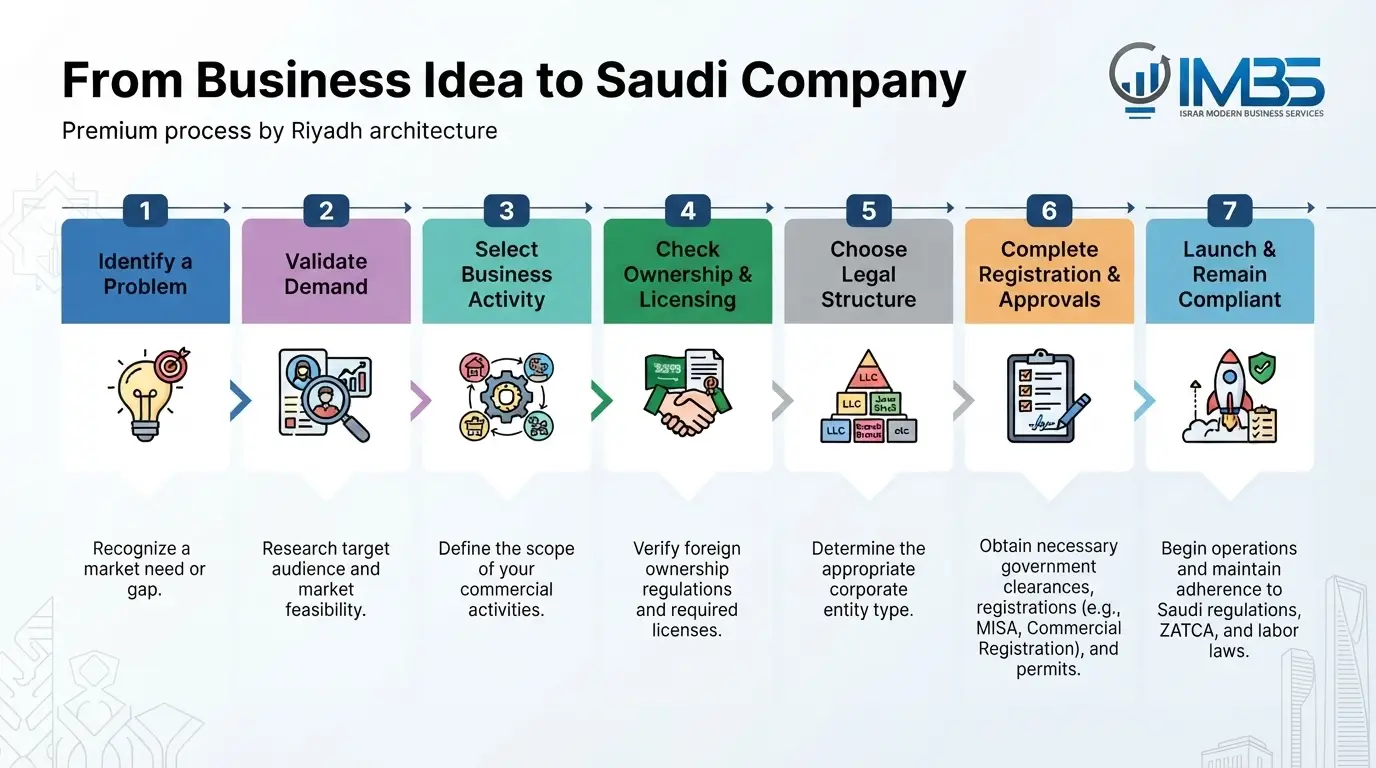
Don’t register a company simply because you have found an interesting business idea.
Use this sequence instead:
What customer problem are you solving?
Talk to potential customers.
Search competitors.
Check existing prices.
Test a landing page or small offer where appropriate.
Will you make money through:
This is one of the most important steps in Saudi Arabia.
Your marketing description and your official business activity are not necessarily the same thing.
Determine which registrations, approvals and licenses apply.
Don’t calculate only the registration fee.
Consider:
Your structure should follow your business model, ownership situation and regulatory requirements.
Once the regulatory pathway is clear, proceed with the relevant registration, licensing and operational setup.
Before committing capital, ask yourself:
Who will pay me?
What problem am I solving?
Why will they choose me?
How much can I earn per customer?
How will I find my first 10 customers?
What approvals do I need?
How much money can I lose without putting myself under financial pressure?
Can I actually deliver the product or service consistently?
If you cannot answer these questions, you probably need more validation before registration.
Based on the current official growth signals, I would pay particular attention to:
AI-related commercial registrations increased from 14,163 to 19,042 in 2025.
Cybersecurity registrations increased from 7,689 to 9,766.
E-commerce registrations increased from 40,041 to 43,854.
Tourism trip-organizing registrations increased from 6,476 to 10,665.
Entertainment-related registrations also increased significantly during 2025.
These figures indicate business activity growth, not guaranteed profitability. That distinction matters.
The mistake is starting with:
“What business is profitable?“
A better question is:
“What problem can I solve for a specific Saudi customer, and can I build a legally compliant business around it?“
A profitable opportunity exists where:
Real demand + strong execution + sustainable economics + regulatory fit
come together.
Finding an idea is only the beginning.
Before registering your business, you should confirm the appropriate activity, ownership structure, registration pathway, licensing requirements, expected costs and operational obligations.
IMBS helps investors and entrepreneurs navigate the Saudi business setup process — from choosing the appropriate structure and understanding regulatory requirements to company formation, licensing and post-setup support.
Have a business idea but don’t know where to start?
Use the IMBS Company Formation Advisor to assess your situation, or speak with an IMBS business setup specialist.
There is no single best business for everyone. E-commerce, AI, cybersecurity, digital services, tourism, logistics, professional services and other sectors show strong opportunity signals, but the best choice depends on your skills, capital, target market and regulatory requirements.
Skill-based businesses such as consulting, digital marketing, software services, AI automation and professional services can be attractive because they may require less initial capital than inventory-heavy or physical businesses. The applicable business activity and licensing requirements should still be checked.
Foreign investors can invest in Saudi Arabia subject to the applicable Investment Law, regulations, activity eligibility and required registrations or approvals. A foreign investor must register with the Ministry before engaging in an investment, subject to the applicable rules.
Yes, online businesses can operate in Saudi Arabia, but the requirements depend on the business activity and legal form. E-commerce businesses must also comply with the applicable e-commerce framework and consumer requirements.
There is no single fixed cost. Total setup costs depend on the legal structure, business activity, ownership, licenses, premises, employees and other requirements. Government fees are only one part of the total startup budget.
The requirement depends on the business model and legal form. Saudi Arabia provides Commercial Registration services through the Saudi Business Center, and e-commerce store verification has specific requirements.
For taxable persons, ZATCA states that mandatory VAT registration generally applies when annual taxable supplies exceed SAR 375,000. Voluntary registration may be available above SAR 187,500, subject to the applicable rules.
The appropriate structure depends on ownership, business activity, liability, investment plans and regulatory requirements. Foreign investors should also confirm the activity’s eligibility and applicable investment requirements before selecting a structure.
Find answers to common questions about Best Business Ideas in Saudi Arabia.