Explore opportunities to establish and grow a business in one of the world’s most dynamic investment markets. IMBS helps international investors understand Saudi market entry, investment registration, company formation, ownership considerations, licensing and the regulatory steps required to establish operations in the Kingdom.
Saudi Arabia has developed an increasingly investor-focused business environment as the Kingdom advances economic diversification under Vision 2030.
The investment landscape spans sectors including technology, manufacturing, tourism, healthcare, logistics, energy, mining, financial services, agriculture and real estate. Invest Saudi, the Ministry of Investment‘s investment platform, highlights the Kingdom’s strategic location, infrastructure, economic diversification and investment opportunities as key factors for international investors.
For a foreign investor, however, identifying an attractive opportunity is only the beginning.
A successful Saudi market-entry strategy also requires understanding:
IMBS helps investors connect these requirements into a practical Saudi business setup pathway.
Saudi Arabia strategic location, infrastructure, economic diversification and investment opportunities as key factors for international investors.
01
Saudi Arabia’s Vision 2030 is driving economic diversification and creating opportunities across new and established industries.
02
03
Opportunities extend beyond traditional energy into technology, tourism, healthcare, manufacturing, logistics, entertainment and other emerging sectors.
04
Saudi Arabia offers access to a substantial consumer and business market within the Kingdom and the wider GCC region.
05
Large-scale infrastructure and economic development programs are creating opportunities for international businesses and investors.
06
MISA and Invest Saudi provide investor services, information and digital pathways designed to facilitate market entry and business establishment.

Foreign Investment Opportunities in Saudi Arabia The Kingdom's investment landscape includes both established industries and rapidly developing sectors.
The following are Investment Opportunities in Saudi Arabia by Domain Specific
Opportunities across software, artificial intelligence, cybersecurity, cloud computing, digital services and emerging technologies.
Manufacturing, industrial production, advanced manufacturing, processing and supply-chain businesses.
Saudi Arabia's geographic position and infrastructure development create opportunities across logistics, transportation, warehousing and supply chains.
Tourism, hospitality, entertainment and visitor-focused businesses are important areas of economic diversification.
Healthcare services, medical products, pharmaceuticals, health technology and related businesses.
Development, construction, engineering, infrastructure and real-estate-related opportunities.
Opportunities across energy, mining, industrial development and related supply chains.
Financial technology, consulting, corporate services and other professional sectors, subject to applicable regulatory requirements.
This section is one of the most valuable parts of the page.
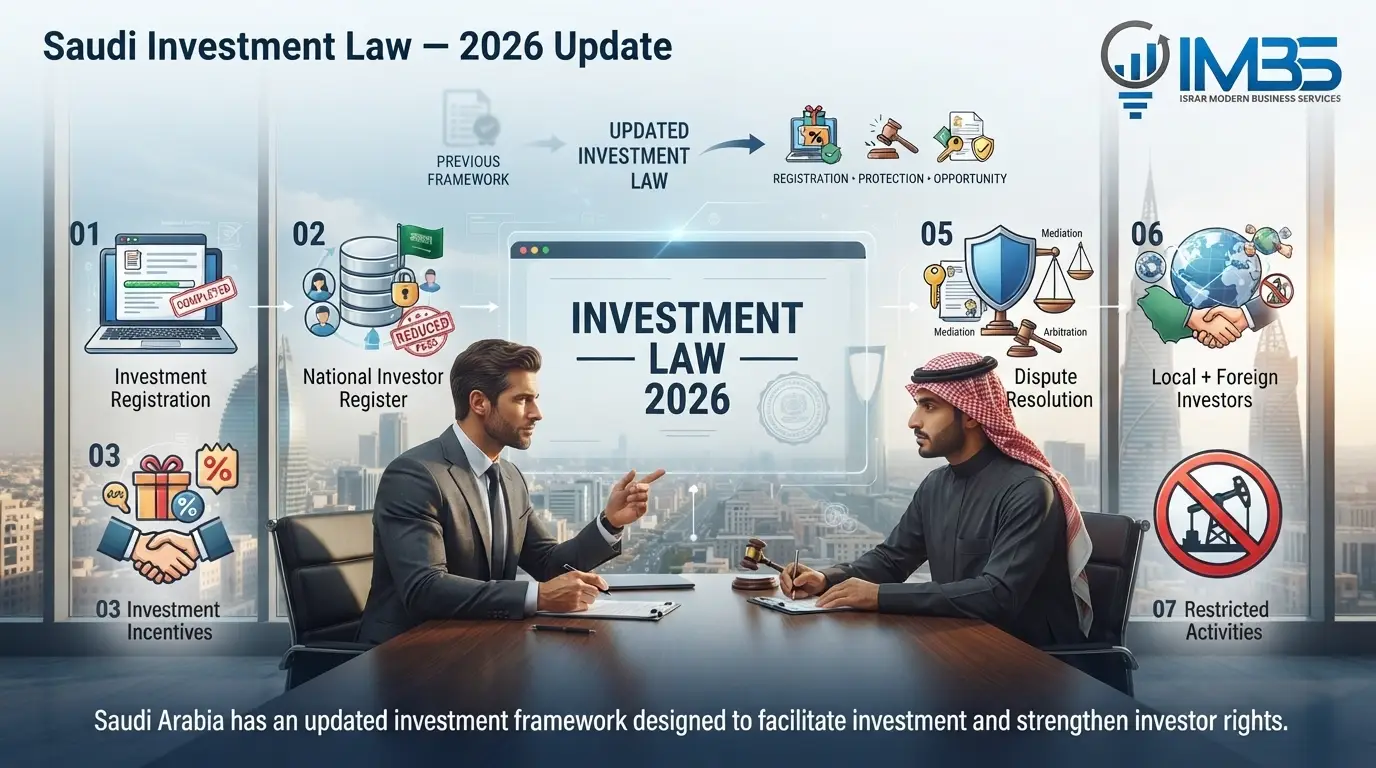
Saudi Arabia’s updated Investment Law replaced the previous Foreign Investment Law and introduced a broader framework designed to improve the investment environment, protect investor rights, facilitate investment and support economic development.
Under the updated framework, the concept of “investor” includes both local and foreign investors, while foreign investors are specifically defined within the law. The law also establishes the principle of freedom of investment, subject to activities included in the applicable excluded/restricted list and other legal requirements.
Under the updated Investment Law, a foreign investor must register with the Ministry of Investment before engaging in investment activities in Saudi Arabia, subject to the applicable regulations.
MISA’s current framework describes a national investor register and states that foreign investors must register before carrying out investment activities.
After receiving notification that the registration has been completed, MISA states that the foreign investor can proceed with issuing a Commercial Registration and obtaining the necessary licenses from competent authorities.
MISA registration ≠ Commercial Registration ≠ Business License
MISA’s updated Investment Law specifically describes foreign-investor registration before investment, followed by the ability to issue a Commercial Registration and obtain necessary licenses after registration completion.
01
Define the proposed investment, business model, ownership and Saudi market-entry objectives.
02
Identify the proposed business activities and check whether any restrictions, approvals or special requirements apply.
03
Complete the applicable registration process with MISA before conducting investment activities, in accordance with the current regulatory framework.
04
Establish the appropriate Saudi business structure based on the investment model.
05
Obtain the relevant Commercial Registration and licenses or permits required for the selected business activity.
06
Set up the operational infrastructure and maintain the registrations, licenses and compliance obligations applicable to the business.
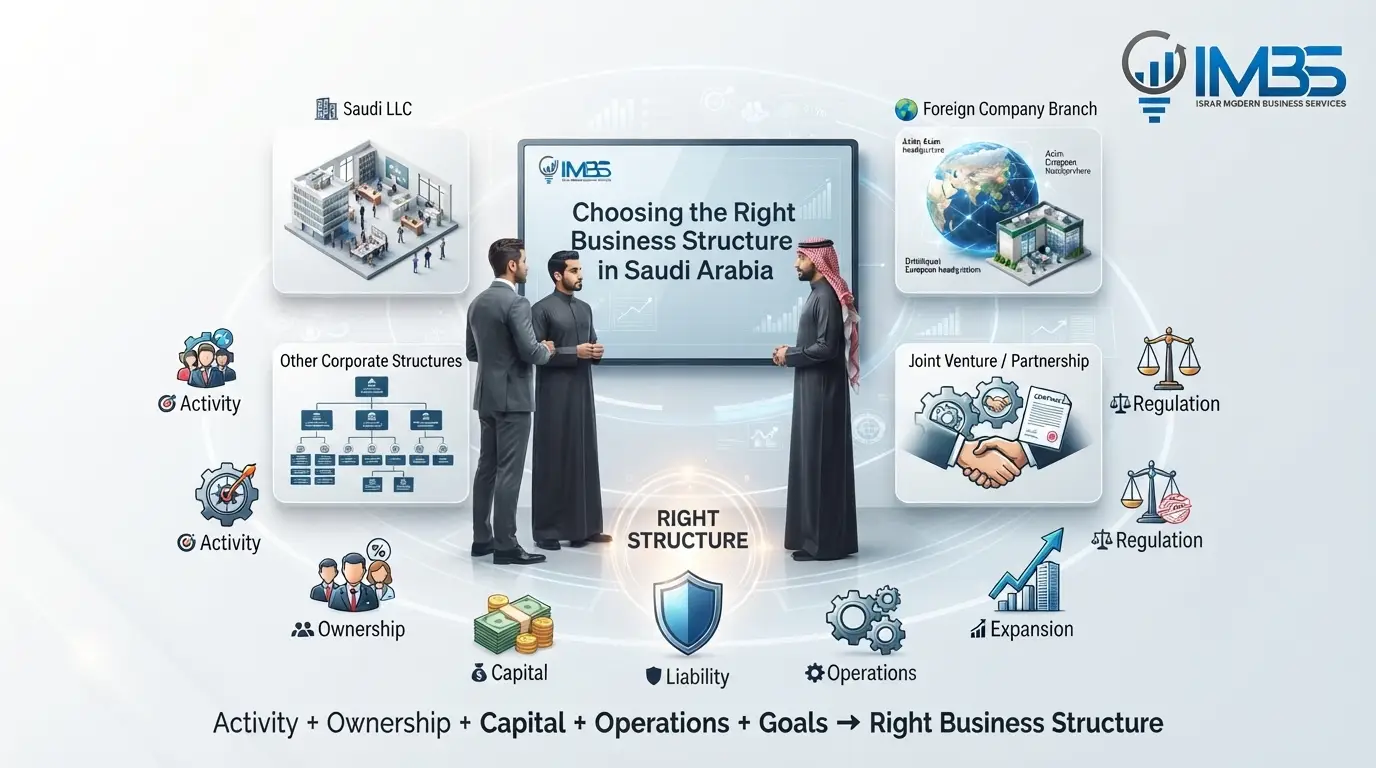
The right structure depends on the investor's objectives, ownership model, activities and long-term plans.
A common corporate structure for businesses establishing an operating company in Saudi Arabia, subject to applicable requirements.
Learn more → LLC Company Formation
An international company may establish a Saudi branch where the applicable requirements are satisfied.
Certain investors may consider partnership structures depending on the activity, commercial objectives and applicable regulations.
Saudi Arabia provides additional legal structures that may be appropriate depending on the company’s size, investment model and intended operations.
There is no universal “best structure” for every foreign investor.
The appropriate choice should be assessed against:
No.
The updated Investment Law generally follows the principle of freedom of investment, but certain activities can be placed on an excluded/restricted list.
Investors seeking to invest in restricted activities may need to submit a request for approval through MISA, which can coordinate with the relevant government authority.
1. What is the exact business activity?
2. Is the activity open to foreign investment?
3. Are additional approvals required?
4. Are there ownership conditions?
5. Does the activity require a specialized license?
Potential requirements can include:
Requirements can differ depending on whether the investor is:
Saudi Arabia can be approached through different market-entry strategies.
01
Create a new Saudi entity designed around your intended Saudi operations.
02
An existing international company may consider establishing a Saudi branch where permitted.
03
Some businesses may enter through partnerships or joint ventures depending on the industry.
04
International companies can establish a Saudi presence as part of a wider regional growth strategy.
05
For companies unfamiliar with the Kingdom, a market assessment can help determine whether the opportunity, regulatory environment and operating requirements align with their objectives.
Key Industries for Foreign Investment in Saudi Arabia
Invest Saudi currently highlights sectors including technology, energy, manufacturing, tourism, entertainment, healthcare, mining, agriculture, financial services, logistics and real estate.
AI, software, cybersecurity, cloud computing and digital transformation.
Advanced manufacturing, industrial production and supply-chain development.
Hotels, restaurants, tourism services and entertainment.
Healthcare delivery, pharmaceuticals, medical technology and life sciences.
Transportation, warehousing, supply chain and distribution.
Energy development, renewable energy and supporting industries.
Mineral resources, processing and mining-related services.
Development, infrastructure, construction and engineering.
01
Understand the practical steps involved in establishing your Saudi operation.
02
Our approach is designed around the needs of international investors and companies entering the Kingdom.
03
We help identify the relevant regulatory pathway based on your proposed activities.
04
From structure selection to incorporation and Commercial Registration, we can coordinate the business establishment process.
06
Our wider services include PRO, compliance, licensing and corporate support after establishment.
Yes. Saudi Arabia’s updated Investment Law establishes a general principle of freedom of investment while allowing restrictions or prior approvals for certain activities. Foreign investors must comply with the applicable registration and regulatory requirements.
Foreign ownership depends on the selected business activity and applicable regulations. Some activities may allow foreign ownership without a local partner, while others can have ownership conditions or require additional approvals. MISA specifically states that the requirement for a local partner depends on the selected activity.
MISA registration is the investment-registration process applicable to foreign investors under Saudi Arabia’s updated investment framework. A foreign investor must register with the Ministry before engaging in investment activities, subject to applicable regulations.
No. MISA investment registration and Commercial Registration are separate parts of the business establishment process. Under the updated framework, a foreign investor can proceed to issue a Commercial Registration after receiving notification that the investment registration has been completed.
Investment is generally permitted under the principle of freedom of investment, but certain activities can be restricted or require prior approval. Investors should check the applicable activity and current excluded/restricted list before establishing the business.
Opportunities exist across technology, manufacturing, tourism, healthcare, logistics, energy, mining, real estate, financial services and other sectors. The appropriate opportunity depends on the investor’s expertise, capital, business model and market strategy.
Requirements vary according to the investor, business structure and activity. They may include corporate documents, identification, ownership information, constitutional documents, legalized documents, translations and activity-specific approvals.
Yes. IMBS can assist with market-entry planning, investment-registration guidance, company formation, Commercial Registration, licensing, PRO services and related corporate support.
Find answers to common questions about IMBS Foreign Investmentin Saudi Arabia.