LLC Company Formation in Saudi Arabia for Foreign and Local Investors
LLC company formation in Saudi Arabia is one of the most popular routes for entrepreneurs, foreign investors, international companies and local business owners who want to establish a legally separate commercial entity in the Kingdom.
A Saudi limited liability company can generally be established by one or more individuals or legal entities. The company has financial liability separate from its shareholders, and the shareholders’ responsibility is normally limited to their respective contributions to the company’s capital.
This structure makes an LLC suitable for many activities, including consulting, technology, trading, logistics, construction, healthcare, education, manufacturing, e-commerce and professional services.
Foreign investors may also be able to establish a 100% foreign-owned LLC in Saudi Arabia for eligible activities. However, foreign ownership, investment registration, capital requirements and sector approvals depend on the proposed activity and the investor’s circumstances.
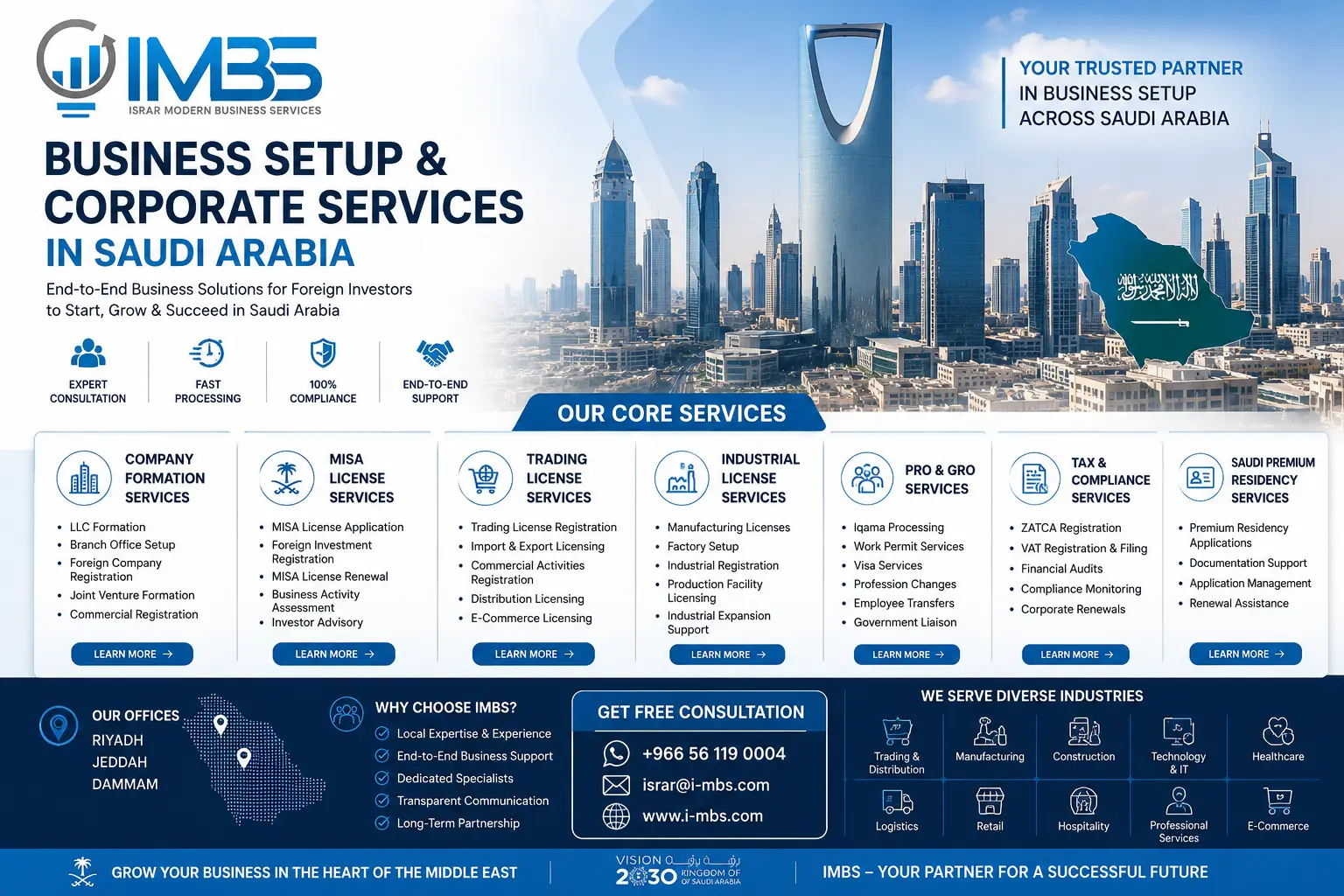
IMBS supports local and international investors throughout the Saudi LLC formation process, including activity assessment, MISA investment registration, company incorporation, Commercial Registration, Articles of Association, government registrations and post-formation compliance.
What Is a Limited Liability Company in Saudi Arabia?
A limited liability company, commonly called an LLC, is a separate legal entity formed by one or more shareholders.
The LLC itself is responsible for the debts and obligations arising from its activities. Its owners or partners are generally not personally responsible for those obligations beyond their respective contributions to the company’s capital, subject to applicable law and exceptional circumstances.
An LLC can usually:
- Enter into commercial contracts
- Employ workers
- Lease offices, warehouses or facilities
- Open a corporate bank account
- Issue invoices
- Own permitted assets
- Apply for business licenses
- Register with tax and labour authorities
- Conduct approved commercial activities
- Establish branches where permitted
The activities stated in the company’s constitutional documents and Commercial Registration determine what the business is legally authorized to perform.
Why Is an LLC Popular in Saudi Arabia?
The limited liability company structure provides a balance between legal protection, commercial credibility and operational flexibility.
Major advantages can include:
- Separate legal personality
- Limited shareholder liability
- One or more shareholders
- Eligibility for many commercial activities
- Potential 100% foreign ownership for approved activities
- Flexible management arrangements
- Greater credibility with banks, clients and suppliers
- Ability to employ staff
- Ability to establish branches
- Suitability for small, medium and large businesses
- Easier continuity than a sole proprietorship
- Clear shareholder ownership percentages
An LLC is commonly selected by investors who want a formal Saudi operating entity without using a joint-stock company structure.
Can a Foreigner Establish an LLC in Saudi Arabia?
Yes. Foreign individuals and foreign legal entities may establish an LLC in Saudi Arabia, subject to the Investment Law, activity eligibility and regulatory requirements.
A foreign investor may need to complete investment registration with the Ministry of Investment of Saudi Arabia before incorporating the company through the Saudi Business Center.
The exact process depends on:
- The proposed business activity
- Whether the shareholder is an individual or company
- The investor’s nationality
- The parent company’s existing activities
- The ownership structure
- Capital requirements
- Professional or sector licensing
- Whether the activity is open to foreign investment
- The planned location and operating model
Foreign investors should confirm the correct activity and licensing route before preparing or authenticating documents.
For detailed foreign-investment guidance, review the IMBS page on MISA company setup in Saudi Arabia.
Can an LLC Be 100% Foreign-Owned in Saudi Arabia?
Many approved business activities may qualify for 100% foreign ownership in Saudi Arabia.
This means an eligible foreign investor may establish an LLC without giving ownership shares to a Saudi partner.
However, 100% foreign ownership is not automatically available for every activity. Eligibility may depend on:
- Business activity classification
- Investment registration requirements
- Sector-specific regulations
- Professional licensing
- Capital conditions
- Investor experience
- Parent-company records
- Additional authority approvals
- Restrictions applicable to certain activities
Investors should avoid assuming that a general description such as “trading,” “consulting,” or “construction” is enough. The precise activity must be assessed.
IMBS reviews the proposed activity and ownership plan before recommending the company structure and registration route.
Who Can Be a Shareholder in a Saudi LLC?
A Saudi LLC may be formed by eligible:
- Saudi individuals
- Saudi companies
- GCC nationals
- Foreign individuals
- Foreign companies
- A combination of local and foreign shareholders
- A single shareholder, where permitted
- Multiple individuals or legal entities
A shareholder may contribute cash or, where accepted and properly valued, an in-kind contribution.
The ownership percentage, capital contribution, voting arrangements and profit distribution should be clearly addressed in the Articles of Association and related shareholder documents.
Single-Shareholder LLC in Saudi Arabia
A limited liability company may be established with one shareholder where the applicable requirements are satisfied.
A single-shareholder LLC can be suitable for:
- An overseas parent company establishing a Saudi subsidiary
- A foreign entrepreneur qualifying for investment registration
- A Saudi investor separating business and personal liability
- A group creating a wholly owned subsidiary
- An investor launching a dedicated Saudi business unit
The single owner controls the company but must still maintain proper company records, accounting, regulatory compliance and separation between personal and corporate finances.
Saudi LLC Versus a Foreign Company Branch
Foreign investors often compare an LLC with a foreign-company branch.
| Factor | Saudi LLC | Foreign-company branch |
|---|
| Legal identity | Separate Saudi legal entity | Extension of the foreign parent company |
| Liability | Normally limited to company assets and shareholder contributions | Parent company may remain responsible for branch obligations |
| Ownership | Shares held by one or more owners | Fully connected to the parent company |
| Corporate documents | Saudi Articles of Association | Parent-company resolution and branch documentation |
| Activities | Approved activities stated for the LLC | Usually aligned with parent-company activities |
| Best suited for | Investors wanting a separate Saudi subsidiary | Existing foreign companies wanting direct Saudi operations |
| Future investors | Shares may be transferred or new partners admitted subject to rules | Not normally structured for separate branch shareholders |
An LLC may be preferable when an investor wants a separate Saudi subsidiary, limited shareholder liability and flexibility in ownership.
A branch may be more suitable when an established overseas company wants to operate directly through its existing corporate identity.
The final decision should consider tax, legal, operational, ownership and commercial factors.
Business Activities Suitable for an LLC
An LLC may be used for many approved Saudi business activities.
Common examples include:
Consulting and Professional Services
- Management consulting
- Business consulting
- Marketing services
- Information technology consulting
- Engineering support
- Project management
- Human resources consulting
- Research services
Professional activities may require qualifications, professional partners or additional approvals.
Technology and Software
- Software development
- SaaS platforms
- Artificial intelligence services
- Cybersecurity
- Cloud services
- IT support
- Application development
- Digital transformation consulting
Trading and E-commerce
- Wholesale trading
- Retail activity
- Import and export
- Product distribution
- E-commerce
- Commercial agency activities where permitted
Foreign-owned trading companies may face different conditions from service companies and should receive an activity-specific assessment.
Construction and Engineering
- General contracting
- Specialized construction
- Engineering services
- Maintenance
- Interior fit-out
- Infrastructure services
- Building-material supply
Logistics and Transportation
- Warehousing
- Supply-chain services
- Freight support
- Distribution
- Transportation activity
- Delivery services
Transportation and logistics activities may require additional licenses.
Industrial and Manufacturing
- Manufacturing
- Product assembly
- Food production
- Industrial processing
- Equipment production
- Packaging
Industrial projects may need an industrial license, suitable premises and other operational approvals.
Investors considering an industrial company can review IMBS support for business setup in Dammam, a key Eastern Province location for manufacturing and logistics.
Requirements for LLC Company Formation in Saudi Arabia
The exact requirements depend on the shareholders, activity and ownership structure.
Common requirements may include:
- Approved business activities
- Eligible shareholders
- Investment registration for foreign investors, where required
- Reserved trade name
- Articles of Association
- Company capital information
- Manager or management structure
- Registered Saudi address
- Commercial Registration information
- Shareholder identification
- Beneficial-owner information
- Professional or sector approvals
- Foreign-document authentication and translation
- Payment of applicable government fees
Additional documents or approvals may be requested depending on the activity.
Documents Required for a Foreign Corporate Shareholder
A foreign company establishing a Saudi LLC may commonly need:
- Certificate of incorporation
- Foreign Commercial Registration
- Memorandum and Articles of Association
- Board resolution approving the Saudi investment
- Board resolution appointing an authorized representative
- Power of attorney
- Audited financial statements
- Company profile
- Shareholder information
- Beneficial-owner information
- Passport or identification of authorized representatives
- Business activity description
- Arabic translations
- Authentication or legalization where required
The company name, registration details, shareholders and authorized representatives should remain consistent across all documents.
Inconsistencies can delay investment registration and company incorporation.
Documents Required for Individual Shareholders
An individual investor may commonly need:
- Valid passport or national identification
- Contact details
- Residential address
- Proposed business activities
- Ownership information
- Financial information where required
- Professional qualifications for regulated activities
- Power of attorney if using a representative
- Supporting investment documents
- Translated or authenticated records where necessary
Requirements may differ for Saudi, GCC and foreign shareholders.
Step-by-Step LLC Formation Process in Saudi Arabia
Step 1: Define the Business Activity
The process begins by identifying exactly what the company will do.
The activity affects:
- Foreign ownership eligibility
- MISA investment registration
- Capital conditions
- Company name
- Commercial Registration
- Municipality approvals
- Professional licensing
- Saudization obligations
- Office or facility requirements
A broad description should be converted into the correct Saudi activity classification before incorporation begins.
Step 2: Confirm Foreign Investment Eligibility
Foreign investors should confirm whether:
- The activity is open to investment
- Full foreign ownership is available
- Additional approvals are required
- The applicant qualifies for investment registration
- Capital or experience requirements apply
- A Saudi partner is required for any regulated activity
This assessment should happen before foreign documents are authenticated.
Step 3: Choose the Shareholding Structure
Decide:
- Who will own the company
- Ownership percentages
- Whether the owner is an individual or legal entity
- Capital contributions
- Voting arrangements
- Profit distribution
- Management powers
- Transfer restrictions
- Exit arrangements
These decisions influence the Articles of Association.
Step 4: Prepare and Authenticate Documents
Foreign corporate documents may need:
- Authentication
- Legalization
- Arabic translation
- Updated issue dates
- Supporting board resolutions
- Powers of attorney
The exact authentication process depends on the originating country and current Saudi procedures.
Step 5: Complete Investment Registration
Where required, the foreign investor applies for investment registration.
The application may include:
- Investor details
- Shareholder details
- Beneficial ownership
- Business activity
- Proposed company structure
- Financial information
- Supporting company documents
- Sector-specific approvals
After successful registration, the investor can proceed with company incorporation.
Step 6: Reserve the Trade Name
The proposed company name must comply with Saudi naming requirements.
The trade name should:
- Be available
- Avoid restricted words
- Match the company’s identity
- Be appropriate for the approved activities
- Follow Arabic and English naming requirements where relevant
Step 7: Prepare the Articles of Association
The Articles of Association form the company’s main constitutional document.
They commonly address:
- Company name
- Headquarters
- Business activities
- Duration
- Shareholders
- Capital
- Ownership percentages
- Management
- Manager powers
- Partner decisions
- Profit and loss distribution
- Share transfers
- Dissolution
- Dispute procedures
Shareholders should review the document carefully before approval.
Step 8: Submit the LLC Incorporation Application
The incorporation application is generally completed electronically through the Saudi Business Center.
The application may require:
- Number of partners
- Company status
- Registration duration
- Headquarters
- Activities and purposes
- Partner information
- Commercial registry information
- Company details
- Management details
- Articles of Association information
Step 9: Obtain the Commercial Registration
Once the incorporation requirements are completed, the company receives its Commercial Registration.
The Commercial Registration identifies important company information, including:
- Legal name
- Registration number
- Business activities
- Headquarters
- Company status
- Management details
The company should conduct only the activities for which it is properly registered and licensed.
Step 10: Complete Post-Incorporation Registrations
LLC registration does not end with the Commercial Registration.
Additional steps may include:
- Chamber of Commerce registration
- National Address
- ZATCA registration
- VAT registration where applicable
- E-invoicing preparation
- GOSI registration
- Ministry of Human Resources business file
- Qiwa registration
- Muqeem registration
- Mudad setup
- Municipality license
- Sector-specific permits
- Corporate bank account
- Employee and visa processes
IMBS provides ongoing PRO and government-relations support for companies requiring assistance after incorporation.
How Long Does LLC Formation Take in Saudi Arabia?
There is no universal timeline for every LLC.
The formation period depends on:
- Business activity
- Investor type
- Document availability
- Authentication and translation
- Investment registration
- Number of shareholders
- Authority approvals
- Corrections requested
- Regulated-sector licensing
- Manager approvals
- Post-incorporation requirements
A straightforward LLC with complete documents and a non-regulated activity may progress more quickly than a trading, industrial, healthcare, financial or professional company requiring additional approvals.
Investors should separate three timelines:
- Investment registration
- Legal company incorporation
- Full operational readiness
Receiving the Commercial Registration does not necessarily mean that every operational license, bank account, employment portal or sector approval is complete.
LLC Formation Cost in Saudi Arabia
The total cost varies according to the company structure and activity.
Potential costs include:
- Investment-registration fees
- Company incorporation fees
- Trade-name reservation
- Articles of Association
- Commercial Registration
- Chamber subscription
- National Address
- Translation
- Document authentication
- Professional advice
- Municipality licensing
- Sector-specific licenses
- Office or facility rent
- Industrial or warehouse requirements
- PRO services
- Employee registration
- Corporate banking preparation
Avoid relying on a single advertised package price without confirming what it includes.
Ask whether the quotation includes:
- Government fees
- Investment registration
- Translation
- Authentication
- Commercial Registration
- Articles of Association
- Registered address
- Municipality license
- Tax registration
- Labour registrations
- Bank-account assistance
- Post-formation support
IMBS prepares a customized assessment after reviewing the activity, shareholders and required services.
Does a Saudi LLC Require Minimum Capital?
Capital requirements can depend on:
- Business activity
- Foreign ownership route
- Investment-registration category
- Sector regulator
- Trading activity
- Industrial activity
- Professional licensing
- Shareholder structure
Some activities may not have the same fixed minimum capital requirement, while others can have substantial financial or investment conditions.
The correct capital should therefore be determined from the specific activity and current regulatory requirements rather than from a general online estimate.
Management of a Saudi LLC
An LLC may be managed by one or more managers, subject to its Articles of Association and shareholder decisions.
The manager may be:
- A shareholder
- A non-shareholder
- A Saudi national
- A qualifying foreign national
- One of several jointly appointed managers
The Articles should define:
- Appointment period
- Signing powers
- Banking authority
- Contract authority
- Hiring authority
- Borrowing powers
- Limits requiring shareholder approval
- Removal procedures
- Representation before authorities
Clear management provisions reduce disputes and operational delays.
Tax and Accounting Obligations
A Saudi LLC must comply with applicable accounting, financial-reporting and tax requirements.
Depending on ownership and activity, obligations may include:
- Zakat or corporate income tax
- VAT registration
- VAT returns
- Withholding tax
- Transfer-pricing requirements
- E-invoicing
- Bookkeeping
- Audited financial statements
- Financial-statement filing
- Payroll records
- Customs obligations
Tax treatment can differ between Saudi-owned, GCC-owned and foreign-owned companies.
Investors should obtain professional tax advice based on the final ownership and transaction structure.
Employment and Saudization Requirements
An LLC planning to hire employees may need to complete registrations with:
- Ministry of Human Resources and Social Development
- GOSI
- Qiwa
- Muqeem
- Mudad
- Health-insurance providers
- Other relevant employment platforms
The company may also be subject to Saudization and Nitaqat requirements.
The applicable Saudi employment ratio can depend on:
- Business activity
- Company size
- Employee roles
- Sector rules
- Wage levels
- Company classification
Workforce planning should be considered before hiring expatriate employees.
Annual and Ongoing LLC Compliance
After company formation, the LLC must remain compliant.
Common ongoing responsibilities may include:
- Maintaining accurate Commercial Registration data
- Annual confirmation of company information
- Renewing licenses
- Updating shareholder and manager information
- Maintaining accounting records
- Filing financial statements
- Submitting tax returns
- Maintaining National Address information
- Complying with labour requirements
- Updating beneficial-owner data
- Maintaining investment registration
- Renewing municipality and sector permits
- Monitoring Saudization
- Holding and documenting partner decisions
Failure to maintain compliance may lead to fines, service suspension, registration problems or operational delays.
Common LLC Formation Mistakes
Selecting the Wrong Business Activity
The activity determines ownership, licensing, capital and operational requirements.
Assuming Every Activity Allows 100% Foreign Ownership
Full foreign ownership is available for many activities but not universally guaranteed.
Authenticating Documents Before Confirming Requirements
Incorrect or unnecessary authentication can create extra costs and delays.
Using Inconsistent Company Information
Names, shareholder details and registration numbers should match across documents.
Ignoring Post-Incorporation Requirements
A CR alone may not make the company operational.
Choosing an LLC Without Comparing a Branch
Some foreign companies may benefit from a branch structure instead.
Underestimating Employment Compliance
Saudization, labour registrations and employee documentation should be planned early.
Using a General Online Cost Estimate
Actual costs depend on the activity, structure and scope of support.
Best Saudi City for LLC Formation
Riyadh
Riyadh is suitable for:
- Corporate headquarters
- Consulting
- Technology
- Financial services
- Government contracting
- Professional services
- Regional management
Explore business setup in Riyadh.
Jeddah
Jeddah is attractive for:
- Trading
- Import and export
- Logistics
- Tourism
- Hospitality
- Food businesses
- Western Region operations
Explore business setup in Jeddah.
Dammam
Dammam is suitable for:
- Industrial operations
- Manufacturing
- Energy-sector services
- Logistics
- Engineering
- Warehousing
- Eastern Province investment
Explore business setup in Dammam.
Why Choose IMBS for Saudi LLC Formation?
IMBS supports investors from initial planning through operational readiness.
Our services can include:
- Business activity assessment
- Foreign ownership review
- LLC versus branch comparison
- MISA investment-registration support
- Document checklist preparation
- Foreign-document review
- Trade-name reservation
- Articles of Association
- Company incorporation
- Commercial Registration
- Chamber registration
- National Address
- ZATCA support
- GOSI and labour registration
- Qiwa, Muqeem and Mudad support
- Municipality and sector licensing
- Corporate bank-account preparation
- Ongoing PRO services
- Compliance and renewal support
Our goal is to help investors choose the correct structure before committing time and money to the registration process.
Start Your LLC Company Formation in Saudi Arabia
LLC company formation in Saudi Arabia can provide foreign and local investors with limited liability, commercial credibility, operational flexibility and access to one of the region’s most important markets.
The right setup depends on:
- Your business activity
- Shareholder type
- Ownership plan
- Company structure
- Investment-registration route
- Required licenses
- Target city
- Workforce plan
- Long-term objectives
IMBS can assess your proposed activity, explain whether 100% foreign ownership may be available and prepare a clear roadmap for company incorporation and post-formation compliance.
Get My Saudi LLC Formation Assessment
Speak With an IMBS Company Formation Advisor